Mold Testing: Every Method Compared
If you have ever searched for a mold test, you have met a wall of options: dust tests, ERMI, HERTSMI-2, air cassettes, tape lifts, petri dishes and swabs, each with confident marketing and wildly different prices. The truth is simpler and more useful than the hype: there is no single best mold test. Each method measures a different thing, and the right choice depends on the exact question you are trying to answer. This guide compares every common method side by side so you can choose deliberately — and interpret the results without being misled.
The short answer
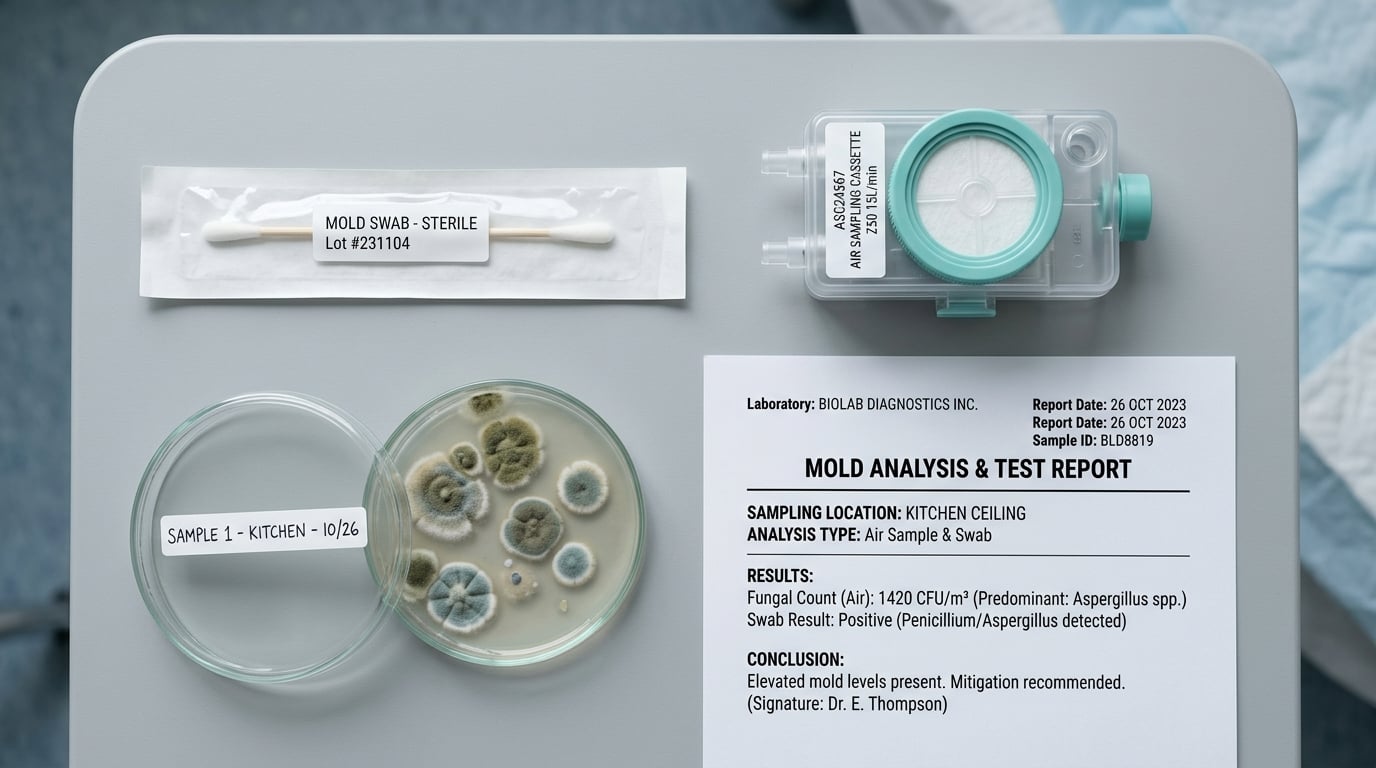
Mold testing methods fall into two families: environmental tests that sample your home (settled-dust DNA panels like ERMI/HERTSMI-2 and the EPA 36-species dust screen, air-sampling cassettes, tape lifts, swabs and petri dishes) and clinical tests ordered by a doctor to evaluate a person. For most homeowners, a settled-dust DNA test gives the most stable, whole-home picture of long-term mold burden, air sampling captures a snapshot of what is airborne right now, and tape lifts or swabs identify a specific visible patch. No test replaces finding the moisture source, and no environmental test can diagnose illness — only a licensed clinician can interpret health concerns.
What is Mold testing?
Mold testing is any method used to detect and measure mold in an environment (air, dust, or a surface) or, in a clinical setting, to evaluate a person for mold-related health effects. Environmental testing tells you about a building; it does not, by itself, tell you whether mold is affecting your health.
Quick summary
- No single test is "best" — match the method to your question.
- Settled-dust DNA tests (ERMI, HERTSMI-2, EPA 36-species) show long-term, whole-home burden.
- Air sampling is a real-time snapshot that changes hour to hour.
- Tape lifts and swabs identify one specific visible spot.
- Petri-dish (settling-plate) kits are the least reliable and easiest to misread.
- Testing never replaces fixing the moisture source, and it cannot diagnose illness.
This information is educational and does not diagnose or treat any condition. It is not for emergencies. If you have trouble breathing, chest pain, fainting or other severe symptoms, call your local emergency number right away.
Two very different reasons people "test for mold"
Before comparing kits, separate the two questions people are actually asking, because they need completely different tools.
The first is environmental: "Is there an unusual amount of mold in my home, and where?" That is answered with environmental testing — dust, air or surface samples analyzed by a lab. The second is medical: "Is mold affecting my health?" That question is never answered by a home test kit. It requires a licensed clinician who can weigh your symptoms, history and, when appropriate, clinical labs. This guide is about the first question; we flag the second wherever the line matters.
Key point: A home mold test measures a building, not a body. It can never diagnose an illness on its own.
The methods at a glance
Here is the full landscape in one view. The sections that follow explain each row in depth, but this table is the fastest way to orient yourself.
Common mold testing methods compared
| Method | What it measures | Best for | Typical cost |
|---|---|---|---|
| Settled-dust DNA (ERMI / HERTSMI-2) | DNA of ~36 species in accumulated dust | Long-term, whole-home burden | $150–$300 |
| EPA 36-species dust screen (e.g. The Dust Test) | Species-level DNA + relative abundance in dust | Comprehensive whole-home screen | $150–$300 |
| Air sampling (spore-trap cassette) | Airborne spore counts at that moment | Snapshot of what is airborne now | $200–$600 with inspector |
| Tape lift | What a specific visible patch is | Identifying one visible spot | $20–$60 per sample |
| Swab | Surface growth on one spot | Confirming a suspicious surface | $20–$60 per sample |
| Petri dish / settling plate | Whatever settles/grows in minutes | Almost nothing reliable | $10–$40 |
Prices are rough consumer ranges and vary by lab and region; inspector-collected air sampling costs more because it includes a professional visit.
Settled-dust DNA tests (ERMI, HERTSMI-2 and the EPA 36-species screen)
Settled-dust testing is built on a clever insight: household dust is a diary. Dust accumulates over weeks and months, quietly recording the mold that has been growing and shedding spores in a space. Analyze that dust with DNA sequencing (qPCR) and you get a stable, integrated picture of the home's mold history rather than a single fluctuating moment.
ERMI (the Environmental Relative Moldiness Index) is a research-derived scoring system that analyzes 36 species and combines them into an index. HERTSMI-2 is a streamlined follow-up score using five of the most water-damage-associated species, often used to decide whether a cleaned building is "safe enough" to re-enter. The EPA 36-species dust screen used by consumer services like The Dust Test reports the same species panel with relative abundance so you can see which molds dominate.
The strength of dust testing is stability and breadth: it is hard to "miss" a chronic problem because dust captures the long view of the whole area you sampled. The limitation is that it tells you about accumulated burden, not exactly where the active growth is or what is airborne at this instant.
- Great for: a comprehensive, repeatable whole-home screen and before/after remediation comparison.
- Not ideal for: pinpointing the exact wall cavity, or capturing a sudden airborne spike.
- Collection: you wipe or vacuum dust from agreed surfaces and mail it to the lab — no inspector required.
Key point: Because dust integrates weeks of history, settled-dust DNA tests are the most consistent whole-home screen for most households.
Air sampling (spore-trap cassettes)
Air sampling pulls a measured volume of air through a cassette that traps spores, which a lab then counts and categorizes. It is the classic tool of professional inspectors, usually taken as paired samples — indoors versus outdoors — because the outdoor count is the reference the indoor count is judged against.
Its great advantage is immediacy: it tells you what is airborne right now, which matters for acute exposure questions. Its great weakness is exactly the same thing: airborne spore counts swing dramatically by the hour with activity, ventilation, weather and whether a door was just opened. A single air sample is a photograph, not a movie, and a "clean" reading taken on a calm afternoon can miss a problem that spikes when the HVAC runs.
- Great for: a real-time snapshot, comparing one room to outdoor air, investigating an acute complaint.
- Not ideal for: ruling a home in or out on a single reading — counts are highly variable.
- Best practice: multiple samples, paired with an outdoor control, ideally by an independent inspector.
Tape lifts and swabs (surface tests)
When you can see a suspicious patch, a surface test answers the narrow question "what is this?" A tape lift presses clear tape onto the growth to capture structures for microscopy; a swab wipes the surface for lab analysis. Both are inexpensive and genuinely useful for identifying a specific spot — for instance, confirming that the discoloration behind a toilet is mold rather than staining.
The catch is scope. A surface test describes one square inch you already suspected. It says nothing about the rest of the home, nothing about what is airborne, and nothing about how long the material has been wet. It is a magnifying glass, not a map.
Key point: Surface tests identify a spot you can already see. They cannot characterize a whole home.
Petri-dish (settling-plate) kits — handle with skepticism
The cheap hardware-store kit — leave a petri dish open for an hour, close it, wait for fuzz — is the most popular and least reliable method. Because mold spores are present in all normal air, virtually every plate grows something, which is routinely misread as proof of a dangerous problem. The result depends on random settling and offers no meaningful quantification, no outdoor comparison and no species-level insight useful for decisions.
These kits can occasionally confirm that spores are present (they always are) but they cannot tell you whether your home has an abnormal burden. Most professionals consider them the weakest option for actual decision-making.
- Nearly always grows something — because all air contains spores.
- No reliable quantification and no outdoor control.
- Easy to over-interpret into unnecessary fear or false reassurance.
How to choose the right test for your question
Match the tool to the exact thing you need to learn. The decision is almost always driven by your question, not by which kit is cheapest.
Pick your method by the question you are asking
| Your question | Best method |
|---|---|
| "Is my whole home's mold burden unusually high?" | Settled-dust DNA (ERMI / EPA 36-species) |
| "Did remediation actually work?" | HERTSMI-2 or repeat dust test, before vs. after |
| "What is airborne in this room right now?" | Air sampling with an outdoor control |
| "What is this visible patch?" | Tape lift or swab of that spot |
| "Is mold affecting my health?" | See a licensed clinician — no home test answers this |
Key point: Decide what you need to know first; the correct test follows almost automatically.
Interpreting results without being misled
Every method shares the same interpretation traps. Keep these guardrails in mind so a number on a page does not stampede you into panic or false comfort.
First, detection is not diagnosis: finding mold DNA or spores confirms mold exists (it usually does everywhere) — it does not prove it is making anyone sick. Second, context beats absolutes: indoor readings mean little without an outdoor comparison and knowledge of the building. Third, one sample is weak evidence: trends and repeats are far stronger than a single dramatic number. Finally, no test substitutes for the moisture source — if you have not found and fixed the water, the mold will return regardless of what any lab reports.
- Detection ≠ diagnosis. Mold is present in essentially all buildings.
- Always compare indoor results to an outdoor reference where the method allows.
- Prefer trends and repeat testing over a single snapshot.
- A test result never replaces finding and fixing the moisture source.
Where testing fits in the bigger picture
Testing is a supporting actor, not the lead. The reliable sequence is: use your senses and your home's moisture history to suspect a problem, fix the water source, clean or remediate appropriately, and use testing selectively to answer specific questions — such as verifying that remediation worked. If your interest is health rather than the building, the most important step is not a kit at all; it is a conversation with a licensed clinician who can evaluate you as a whole person.
Key takeaways
- There is no single best mold test — choose the method that answers your specific question.
- Settled-dust DNA tests give the most stable whole-home picture; air sampling is a volatile snapshot.
- Tape lifts and swabs identify one visible spot; petri-dish kits are the least reliable.
- Detection is not diagnosis, and no environmental test can determine whether mold is affecting your health.
- Testing never replaces finding and fixing the moisture source — that always comes first.
Frequently asked questions
What is the best mold test kit for home use?
For a comprehensive whole-home screen, a settled-dust DNA test (such as an ERMI-style panel or the EPA 36-species dust screen) is the most stable and repeatable consumer option because dust integrates weeks of history. Air sampling is better for a real-time snapshot, and tape lifts or swabs are best for identifying one visible patch. The best choice depends on your question, not price.
Is ERMI or HERTSMI-2 better?
They serve different purposes. ERMI analyzes 36 species into a broad index useful for characterizing a home. HERTSMI-2 uses five water-damage-associated species and is often used as a simpler score to decide whether a cleaned building is safe enough to re-enter. Many people use ERMI to characterize and HERTSMI-2 to re-check after remediation.
Can a mold test tell me if I am sick from mold?
No. Environmental mold tests measure a building, not a body. They cannot diagnose illness. Only a licensed clinician can evaluate whether mold may be affecting your health by weighing your symptoms, history and appropriate clinical testing.
Why did my petri-dish test grow so much mold?
Because spores are present in essentially all normal air, an open petri dish almost always grows something. That is not proof of a dangerous problem. Settling-plate kits offer no reliable quantification and no outdoor comparison, which is why professionals consider them the weakest method for decision-making.
Do I even need to test for mold?
Often no. If you can see or smell mold and you know the moisture source, testing rarely changes the plan — you still need to fix the water and clean or remediate. Testing is most valuable to answer a specific question, such as whether a whole-home burden is unusually high or whether remediation succeeded.
How much does mold testing cost?
Consumer settled-dust DNA tests typically run about $150–$300, tape lifts and swabs about $20–$60 per sample, and professional air sampling roughly $200–$600 or more because it includes an inspector visit. Prices vary by lab and region.
Helpful tools for this topic
Educational suggestions — not endorsements. Explore neutral options in the marketplace.
Moisture meter
Detects elevated moisture in walls, wood and flooring so you can find the source before mold takes hold or after a leak.
Explore optionsHEPA air purifier
True-HEPA filtration captures fine airborne particles including mold spores. Sizing the unit to the room (by CADR) matters more than brand.
Explore optionsFree mold-risk assessment
Turn your symptoms and environment into clear next steps in minutes.
Start freeBook a consultation
Get physician-supervised testing and a personalized recovery plan.
See programsReferences & further reading
- EPAU.S. EPA — Mold and moisture resources
- EPAU.S. EPA — A Brief Guide to Mold, Moisture and Your Home
- CDCCDC — Mold: basic facts and testing guidance
This article is for general education only and does not diagnose, treat or replace care from your own licensed clinician. MoldDetox.ai provides physician-supervised, educational health services. It does not provide emergency care. Testing and recommendations support — but do not replace — evaluation by your own licensed clinician.