Everything You Need To Know About Mold
Mold is one of the most misunderstood topics in home health. It is blamed for everything and nothing, marketed with fear, and rarely explained clearly. This guide fixes that. It walks through what mold actually is, why it appears indoors, what the science does and does not say about health, and the practical, no-hype steps to find it, remove it and keep it from coming back.
The short answer
Mold is a type of fungus that grows from microscopic spores wherever there is enough moisture, a food source (like drywall, wood or dust) and time. Indoors it is fundamentally a moisture problem: control water and humidity and you control mold. Small areas can often be cleaned safely by hand, while large or water-damaged areas need professional remediation. Health effects vary widely by person — from none, to allergy and asthma symptoms, to non-specific symptoms in sensitive individuals — so the priority is always to fix the moisture source first and involve a licensed clinician for any health concerns.
What is Mold?
Mold is a group of filamentous fungi that reproduce by releasing tiny airborne spores. These spores are everywhere in normal outdoor and indoor air; they only become a problem when they land on a damp surface and start to grow into visible colonies.
Quick summary
- Mold is a fungus that needs moisture, a food source and time to grow.
- Spores are normal in all air — the issue is active indoor growth.
- “Black mold” is not a single species and color does not equal danger.
- Health responses range from none to allergy, asthma and non-specific symptoms.
- The fix is always moisture-first: find the water, stop it, then clean or remediate.
- Keep indoor humidity around 30–50% and verify it with a cheap hygrometer.
This information is educational and does not diagnose or treat any condition. It is not for emergencies. If you have trouble breathing, chest pain, fainting or other severe symptoms, call your local emergency number right away.
What mold actually is
Mold is a fungus — the same broad kingdom of life as mushrooms and yeast. Unlike plants, fungi cannot make their own food from sunlight; instead they digest the material they grow on. Indoors, that “food” is often the cellulose in drywall paper, wood, cardboard, carpet backing, ceiling tiles and ordinary household dust.
Mold reproduces by releasing spores — microscopic packages that float invisibly through the air. A single colony can release millions of them. Spores are extraordinarily hardy: they can survive dry, hostile conditions for long periods and simply wait. When a spore lands somewhere with enough moisture, it germinates, sends out thread-like filaments called hyphae, and grows into the fuzzy or slimy colony we recognize as mold.
This is the single most important idea in the entire topic: spores are always present in the air, indoors and out. You cannot — and do not need to — eliminate every spore. What matters is whether spores are actively growing into colonies inside your home, and that only happens when moisture is available.
Key point: You can’t remove every spore from the air, and you don’t need to. The goal is to prevent and remove active indoor growth by controlling moisture.
Why mold grows indoors: the four ingredients
Every case of indoor mold comes down to the same short recipe. Remove any one ingredient and growth stops.
- Moisture — the only ingredient you can realistically control. Leaks, floods, condensation and high humidity all supply it.
- A food source — drywall, wood, paper, dust, fabric and other organic materials are everywhere in a home.
- The right temperature — most household molds are comfortable in the same range people are (roughly 40–90°F / 4–32°C).
- Time — given moisture, many molds begin colonizing within 24–48 hours.
The mold growth recipe — and what you can do about each ingredient
| Ingredient | Where it comes from | Can you control it? |
|---|---|---|
| Moisture | Leaks, floods, condensation, humidity | Yes — this is your main lever |
| Food source | Drywall, wood, dust, fabric | Rarely — homes are full of it |
| Temperature | Normal indoor comfort range | No — not practically |
| Time | 24–48 hours after wetting | Yes — dry fast, within 24–48 hrs |
Because food and temperature are almost always available indoors, moisture and speed of drying are where prevention actually happens.
Common places mold hides
Visible mold on a bathroom ceiling is the easy case. The harder — and often more important — growth is the mold you cannot see, because it tracks hidden moisture.
- Behind and under bathroom and kitchen fixtures, sinks and dishwashers
- Inside wall cavities fed by slow plumbing or roof leaks
- Basements, crawlspaces and the underside of subfloors
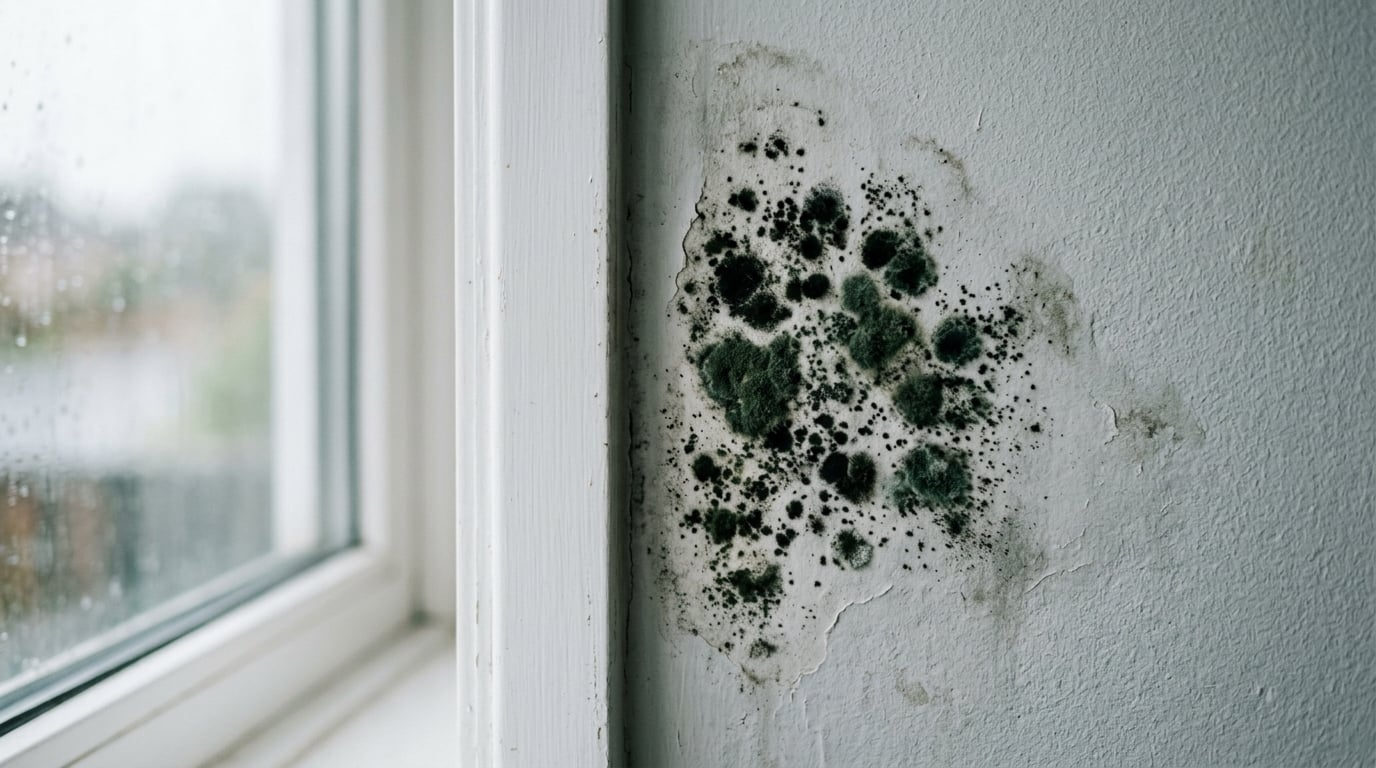
- Around windows where condensation collects
- Behind wallpaper, baseboards and built-in furniture against exterior walls
- In HVAC systems, drip pans and ductwork
- Under carpet padding after a spill or flood that was never fully dried
“Black mold” and what color really tells you
The term “black mold” usually refers to Stachybotrys chartarum, a greenish-black mold that grows on very wet, cellulose-rich materials. It has a fearsome reputation, but the science is more nuanced than the headlines.
Color is not a reliable guide to risk. Many harmless molds are dark, and some concerning molds are light-colored. You cannot identify a species — or its potential to affect health — by looking at it. What a large dark patch does reliably tell you is that a material has been wet for a while, which is a moisture problem worth solving regardless of species.
The practical takeaway is liberating: you do not need to identify the exact species before acting. Whether it is Stachybotrys, Aspergillus, Penicillium or Cladosporium, the response to active indoor growth is the same — protect yourself, fix the water, and clean or remediate appropriately.
Key point: Don’t get stuck trying to identify “black mold” by sight. Visible growth of any color means a moisture problem that needs fixing.
Mold, mycotoxins and health — an honest overview
Some molds can produce mycotoxins — secondary chemical compounds that, in certain conditions, may be found in mold-contaminated environments. This is a real and actively researched area, but it is also heavily oversimplified in marketing. Producing a mycotoxin in a lab dish is not the same as producing meaningful airborne exposure in a specific home, and detecting a compound is not the same as proving it caused a particular person’s symptoms.
What is well established: mold exposure can trigger allergic responses (sneezing, congestion, itchy eyes), can worsen asthma, and can cause respiratory irritation — especially in people who are allergic, asthmatic, very young, elderly or immunocompromised. What is less settled and more individual: the broad, non-specific symptoms (fatigue, brain fog, headaches, mood changes) that some people report in water-damaged buildings.
Because symptoms overlap with so many other conditions, symptoms alone cannot confirm that mold is the cause. That is exactly why a careful process — environmental assessment plus evaluation by a licensed clinician — matters more than any single symptom or test result.
Key point: Testing and symptoms are data points, not diagnoses. Only a licensed clinician can put them together with your history to reach conclusions about your health.
How to know if you have a mold problem
You rarely need a lab to suspect a problem. Your senses and your home’s history are the first and best screening tools.
- You can see it — fuzzy, speckled or slimy patches on walls, ceilings, grout or window frames.
- You can smell it — a persistent musty, earthy odor, especially in basements or closets.
- You have a moisture history — a past flood, roof or plumbing leak, or chronic condensation.
- Symptoms follow the building — people feel worse in one space and better when they leave it.
- Humidity runs high — a hygrometer consistently reads above 50–60%.
Testing options, briefly
Testing is optional and works best to answer a specific question — for example, “Is the mold burden in this room unusually high?” or “Did remediation actually work?” It is not a substitute for finding the moisture source or for medical evaluation.
Common environmental options include settled-dust analysis (such as ERMI/HERTSMI-2 style DNA panels, and the EPA 36 species dust screen used by services like The Dust Test), air-sampling cassettes analyzed by a lab, and simple petri-dish screens. Each has trade-offs in accuracy and interpretation. If you want a deeper look at the most comprehensive consumer option, see the dedicated Dust Test guide.
How to get rid of mold the right way
The correct order of operations almost never starts with bleach. It starts with water.
- Find and fix the moisture source first — cleaning without fixing the leak guarantees regrowth.
- For small areas (roughly under 10 sq ft / ~1 m²), you can often clean carefully yourself with proper protection (fitted N95 or P100 respirator, gloves, eye protection).
- Dry thoroughly and keep the area dry — use fans, a dehumidifier and verify with a hygrometer.
- For large areas, water-damaged building materials, HVAC contamination, or if anyone in the home is highly sensitive, hire a qualified remediation professional.
- Prefer an independent inspector who does not also sell remediation, so the assessment stays unbiased.
Key point: Bleaching a surface while ignoring the leak behind it is the most common mistake in mold cleanup. Fix the water first, every time.
How to prevent mold from coming back
Prevention is almost entirely about moisture management, and most of it is inexpensive.
- Keep indoor relative humidity around 30–50%; run a dehumidifier where needed.
- Place a few cheap hygrometers around the home (bathrooms, basement, closets) to verify.
- Fix leaks fast — dry any wet material within 24–48 hours.
- Ventilate bathrooms and kitchens; run exhaust fans and open windows when practical.
- Use HEPA filtration and high-MERV HVAC filters to reduce circulating particulates.
- Ensure the ground slopes away from the foundation and gutters drain well away from the house.
When to get help — and when it’s an emergency
Bring in a professional when the affected area is large, when building materials are saturated or structurally involved, when the HVAC system is contaminated, or when someone in the home is immunocompromised, asthmatic or highly sensitive.
Seek immediate in-person medical care — call your local emergency number — for severe symptoms such as trouble breathing, chest pain, or fainting. This kind of educational platform is never a substitute for emergency care or for evaluation by your own licensed clinician.
Key takeaways
- Mold is a fungus that grows only where moisture, a food source and time meet — moisture is the lever you control.
- Spores are normal in all air; the real issue is active indoor growth.
- Color, including “black mold,” does not reliably indicate species or danger.
- Fix the water source first — always — then clean small areas yourself or hire a pro for large ones.
- Keep humidity at 30–50%, verify with a hygrometer, and dry any wet materials within 24–48 hours.
- For health concerns, testing and symptoms are clues, not diagnoses — involve a licensed clinician.
Frequently asked questions
Is all mold dangerous?
No. Mold spores are a normal part of every environment and most casual exposure causes no harm in healthy people. Risk depends on the amount of active growth, how long you are exposed, and individual factors like allergies, asthma or a weakened immune system. Regardless of species, visible indoor growth signals a moisture problem worth fixing.
Can I just paint or bleach over mold?
No. Painting or bleaching a surface without fixing the moisture source and removing the growth underneath almost always leads to regrowth. Bleach also does little on porous materials like drywall. Fix the water first, remove contaminated porous material where needed, then clean and dry thoroughly.
How quickly does mold grow after water damage?
Many common molds can begin colonizing within 24 to 48 hours of a material getting wet. That is why drying quickly — with fans and a dehumidifier — is the single most effective way to prevent mold after a spill, leak or flood.
Do I need a professional mold test?
Not always. If you can see or smell mold, you already know you have a moisture problem to fix. Testing is most useful to answer a specific question, such as comparing rooms, investigating hidden growth, or verifying that remediation worked. It is optional and never replaces finding the moisture source or seeing a clinician for health concerns.
What humidity level prevents mold?
Aim to keep indoor relative humidity around 30–50%. Above roughly 60% for extended periods, the risk of condensation and mold rises significantly. A few inexpensive hygrometers let you confirm you are actually staying in range in each room.
Helpful tools for this topic
Educational suggestions — not endorsements. Explore neutral options in the marketplace.
Dehumidifier
Pulls moisture out of the air to hold relative humidity in the 30–50% range, removing the conditions mold needs to grow.
Explore optionsHEPA air purifier
True-HEPA filtration captures fine airborne particles including mold spores. Sizing the unit to the room (by CADR) matters more than brand.
Explore optionsMoisture meter
Detects elevated moisture in walls, wood and flooring so you can find the source before mold takes hold or after a leak.
Explore optionsFree mold-risk assessment
Turn your symptoms and environment into clear next steps in minutes.
Start freeBook a consultation
Get physician-supervised testing and a personalized recovery plan.
See programsReferences & further reading
- EPAEPA — Mold and moisture: A brief guide to mold, moisture and your home
- CDCCDC — Basic facts about mold and dampness
- WHOWHO — Guidelines for indoor air quality: dampness and mould
This article is for general education only and does not diagnose, treat or replace care from your own licensed clinician. MoldDetox.ai provides physician-supervised, educational health services. It does not provide emergency care. Testing and recommendations support — but do not replace — evaluation by your own licensed clinician.