The Complete Guide To The Dust Test
A dust test is one of the most informative tools available to a homeowner who wants objective data about mold. Instead of catching only what happens to be airborne in one moment, it analyzes settled dust — a record of what has accumulated over time. This guide explains exactly how it works, walks through a real sample report structure (including the EPA 36 species panel, water-activity classes and the Mold Code), and shows you how to interpret results responsibly. It is educational only and does not diagnose any illness.
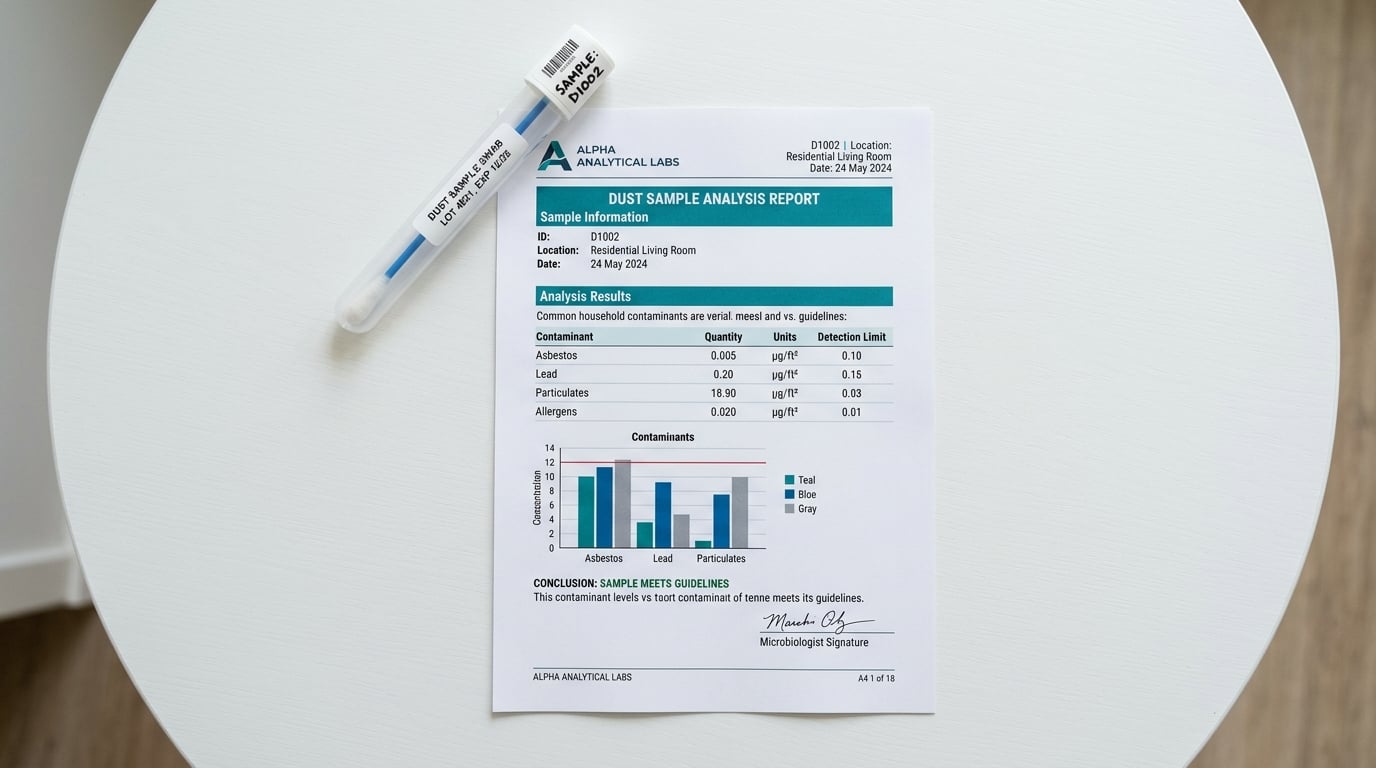
The short answer
A dust test measures the mold DNA present in settled household dust to estimate a home’s mold burden. A common version analyzes an EPA-derived panel of 36 mold species, reports each as spore-equivalents per milligram of dust, sorts them into water-activity classes (xerophilic, mesophilic and hydrophilic) that hint at how much moisture is present, and summarizes the result as a “Mold Code” ranking your home against others. It is an environmental screening tool that helps locate and characterize moisture problems — it is not a medical test and cannot diagnose mold illness.
What is The Dust Test?
A settled-dust mold analysis in which you collect dust from your home (often with a special cloth or swab), send it to a lab, and receive a DNA-based measurement of which mold species are present and in what quantity — used to estimate and compare a home’s mold burden.
Quick summary
- Analyzes settled dust — a time-averaged record, not a single-moment air snapshot.
- Uses DNA (qPCR) to identify and quantify an EPA-derived 36-species panel.
- Sorts molds into water-activity classes that hint at moisture severity.
- Summarizes results as a Mold Code (percentile ranking vs. other homes).
- Great for locating/characterizing moisture and verifying remediation.
- Environmental data only — it does not diagnose illness.
This information is educational and does not diagnose or treat any condition. It is not for emergencies. If you have trouble breathing, chest pain, fainting or other severe symptoms, call your local emergency number right away.
What a dust test is — and why dust
Airborne spore counts change minute to minute with activity, ventilation and weather, so a single air sample can miss intermittent problems. Settled dust behaves differently: it accumulates over weeks and months, effectively averaging the home’s mold history into one sample. That makes dust an unusually stable and informative material to analyze.
Modern dust tests use qPCR (quantitative polymerase chain reaction) to detect and count the DNA of specific mold species. This is the same DNA-based approach behind well-known indices like ERMI and its shorter cousin HERTSMI-2. Because it reads DNA, it can identify species precisely and quantify them even when the mold is dead — which matters, because dead mold can still be relevant.
Key point: Dust integrates the home’s mold history over time, which is why a dust test often reveals problems a one-off air sample would miss.
The EPA 36 species panel
Many dust tests report a panel of 36 mold species derived from research funded and collaborated on by the U.S. Environmental Protection Agency and the Department of Housing and Urban Development, based on the American Healthy Homes Survey. Each species is reported in spore-equivalents per milligram of dust (often abbreviated “Spores E/mg dust”), and results are typically grouped into two clusters — Group 1 and Group 2 — with a “Sum of the Logs” value for each group.
You will frequently see “ND” next to a species, meaning “not detected.” High numbers for particular species are the signal that draws attention. In the sample report used for this guide, for example, Aspergillus ochraceus was reported around 14,897 and Aspergillus sydowii around 7,827 — far above the low readings of most other species — which is the kind of pattern that points toward an indoor moisture source rather than ordinary background dust.
Reading the panel: common terms
| Term | What it means |
|---|---|
| Spores E/mg dust | Estimated spore-equivalents per milligram of dust (the quantity) |
| ND | Not detected in the sample |
| Group 1 / Group 2 | Two species clusters the panel reports separately |
| Sum of the Logs | A combined log-scaled summary of a group’s readings |
| Sample size (e.g., 5 mg) | How much dust was analyzed |
Water-activity classes: the clever part
The most practically useful feature of a dust test is that it sorts detected molds by how much moisture they need to grow. This is measured as water activity (written as aᵥᵥ, on a 0.0–1.0 scale) or, equivalently, as equilibrium relative humidity (ERH). Because different molds colonize at different moisture levels, the mix of species hints at how severe and how recent a moisture problem may be.
The three water-activity classes
| Class | Moisture needed | Colonizes in | Typical locations |
|---|---|---|---|
| Xerophilic (dry-loving) | ~0.65 aᵥ / 65% ERH | 24–48 hours | Poorly ventilated closets, attics; humidity chronically >65% |
| Mesophilic (damp-loving) | 0.80–0.90 aᵥ / 80–90% ERH | 3–7 days | Around showers/tubs, slow under-sink leaks |
| Hydrophilic (water-loving) | 0.90–1.0 aᵥ / 90–100% ERH | 1–2 weeks | Continuous leaks, floods, appliance/toilet leaks |
Finding hydrophilic species such as Stachybotrys or Chaetomium suggests a history of sustained wetting, not just high humidity.
Three important cautions about water activity
The sample report is refreshingly honest about the limits of interpretation, and those cautions are worth repeating:
- Finding molds from all three classes does not necessarily mean you have three separate moisture problems.
- A single moisture source can create all three water-activity environments in the materials around it.
- You cannot determine the total number of water sources simply by counting species within each class.
Key point: Mold needs water to grow but not to remain — once it has grown, it stays until it is physically removed, even after the area dries. So consider past water events, not just current ones.
The Mold Code: how your home compares
To make results digestible, many reports condense everything into a single “Mold Code” — a 1-to-5 ranking of how your home’s mold burden compares to other homes, expressed as percentiles.
Mold Code ranking
| Mold Code | Percentile vs. other homes |
|---|---|
| Code 1 | 1st–9th percentile (very low) |
| Code 2 | 10th–25th percentile |
| Code 3 | 26th–50th percentile |
| Code 4 | 51st–90th percentile |
| Code 5 | 91st–100th percentile (very high) |
A higher code means a higher relative burden — a prompt to investigate sources, not a medical verdict.
How to collect a good sample
Results are only as good as the sample, so follow the lab’s instructions precisely. In general, dust tests ask you to collect settled dust from surfaces that accumulate it over time rather than freshly cleaned areas.
- Choose undisturbed areas — the tops of door frames, shelves, or a room you rarely dust.
- Avoid recently cleaned surfaces, which lack the time-averaged record you want.
- Use the exact cloth/swab and technique the kit specifies; do not substitute.
- Label the location and collection date — the report ties results to that room.
- Follow shipping instructions promptly so the sample arrives in good condition.
Reading a sample report, step by step
Putting it together, here is a sensible way to read a dust-test report without over-interpreting it:
- Start with the Mold Code for the big-picture comparison against other homes.
- Scan the 36-species panel for any standout high numbers versus mostly low/ND readings.
- Note which water-activity classes the elevated species belong to — that hints at moisture severity.
- Cross-reference with what you know: recent leaks, humidity readings, musty rooms.
- Use it to guide inspection — the goal is to find and fix the moisture source, then re-test to verify.
Key point: A dust test tells you a mold source likely exists and roughly how significant it is; a physical inspection tells you where. Use them together.
What a dust test cannot do
It is just as important to know the limits. A dust test is an environmental screening tool, not a diagnosis of your home or your health.
It cannot pinpoint the exact location of hidden mold — that requires inspection. It cannot prove that mold is causing any person’s symptoms; that is a medical question for a licensed clinician who considers your history and environment together. And a single elevated reading is not automatically a crisis, just as a low code does not guarantee there is no hidden problem. Treat the numbers as a starting point for investigation, not a final answer.
Key takeaways
- A dust test uses DNA (qPCR) to measure mold in settled dust — a time-averaged view of a home’s mold burden.
- The EPA-derived 36-species panel reports each species in spore-equivalents per mg of dust, with “ND” meaning not detected.
- Water-activity classes (xerophilic/mesophilic/hydrophilic) hint at how much moisture is present.
- The Mold Code (1–5) ranks your home against others by percentile.
- Mold needs water to grow but not to remain — consider past water events, not just current ones.
- It is environmental data to guide inspection and remediation — it does not diagnose illness.
Frequently asked questions
What is a dust test for mold?
It is a lab analysis of settled household dust that uses DNA testing to identify and quantify mold species — often an EPA-derived panel of 36 species. Because dust accumulates over time, it gives a more stable, time-averaged picture of a home’s mold burden than a single air sample, and it is commonly used to characterize moisture problems and verify remediation.
How is a dust test different from ERMI or an air test?
ERMI and HERTSMI-2 are specific DNA-based dust indices; a dust test uses the same qPCR technology and often reports a similar species panel. Air tests, by contrast, capture only spores airborne at the moment of sampling, so they can miss intermittent problems. Dust testing trades that snapshot for a time-averaged record.
What is a good dust test result?
Lower is generally better — a low Mold Code (1–2) and mostly low or “not detected” species readings suggest a lower relative burden. However, results are always interpreted in context: even a low code does not rule out a hidden localized problem, and a high reading is a prompt to investigate the moisture source rather than a medical diagnosis.
Does a dust test tell me if mold is making me sick?
No. A dust test measures the environment, not your health. It cannot prove that mold is causing symptoms in any individual. Health questions require evaluation by a licensed clinician who considers your history, symptoms and environment together. The sample report referenced in this guide is used purely as an educational example.
Where should I collect the dust sample?
Collect from undisturbed surfaces that accumulate dust over time — such as the tops of door frames or shelves — and avoid recently cleaned areas. Always follow the specific kit instructions for the cloth, technique and shipping, since results depend heavily on correct collection.
Helpful tools for this topic
Educational suggestions — not endorsements. Explore neutral options in the marketplace.
Moisture meter
Detects elevated moisture in walls, wood and flooring so you can find the source before mold takes hold or after a leak.
Explore optionsDehumidifier
Pulls moisture out of the air to hold relative humidity in the 30–50% range, removing the conditions mold needs to grow.
Explore optionsFree mold-risk assessment
Turn your symptoms and environment into clear next steps in minutes.
Start freeBook a consultation
Get physician-supervised testing and a personalized recovery plan.
See programsReferences & further reading
- EPAEPA — ERMI and mold DNA analysis background
- HUDHUD — American Healthy Homes Survey
- IllustrativeThe Dust Test — sample report (educational example only)
This article is for general education only and does not diagnose, treat or replace care from your own licensed clinician. MoldDetox.ai provides physician-supervised, educational health services. It does not provide emergency care. Testing and recommendations support — but do not replace — evaluation by your own licensed clinician.