Water-Damaged Buildings: How to Find and Fix the Source
Every durable solution to indoor mold starts in the same place: the water. Mold is not really a cleaning problem or a chemistry problem — it is a moisture problem wearing a costume. Scrub a wall without fixing the leak behind it and the mold returns on schedule. This guide is the practical companion to that principle: how to find where water is getting in or accumulating, how to dry a building the right way, and how to decide honestly when a job is bigger than a bucket and a fan.
The short answer
To solve mold in a water-damaged building, you must find and stop the moisture source before you clean. Start by hunting the four common water pathways — plumbing leaks, roof and exterior intrusion, condensation, and high indoor humidity — using your senses plus tools like a moisture meter and hygrometer. Fix the source (repair the leak, redirect water, lower humidity), then dry all affected materials within 24–48 hours. Small, non-porous areas under about 10 square feet can often be cleaned safely by a well-protected homeowner; larger areas, saturated porous materials, contaminated HVAC systems, sewage, or sensitive occupants call for professional remediation.
What is Water-damaged building?
A water-damaged building is any structure where unwanted water — from a leak, flood, intrusion or chronic condensation — has wet building materials long enough to risk microbial growth. Because most building materials feed mold, water damage and mold problems are almost always the same problem.
Quick summary
- Mold is a moisture problem — always find and fix the water first.
- Four common pathways: plumbing, roof/exterior, condensation, high humidity.
- A moisture meter and hygrometer turn guesswork into evidence.
- Dry affected materials within 24–48 hours to stop growth.
- Small non-porous areas may be DIY; big or saturated jobs need pros.
- Prefer an independent inspector who does not also sell the remediation.
This information is educational and does not diagnose or treat any condition. It is not for emergencies. If you have trouble breathing, chest pain, fainting or other severe symptoms, call your local emergency number right away.
Why the source comes first, always
It is tempting to attack visible mold directly — reach for bleach, wipe it away, feel accomplished. But visible mold is a symptom. The disease is the water feeding it. If you remove the growth and leave the moisture, you have simply reset a timer; the colony returns, often within weeks, sometimes worse because the material stayed wet.
This is the single most common and expensive mistake in mold cleanup. The correct order of operations is non-negotiable: find the water, stop the water, dry everything, and only then clean or remediate. Every section below serves that sequence.
Key point: Cleaning mold without fixing the water is the most common mistake in the entire field. Source first, every time.
The four water pathways to investigate
Nearly all indoor moisture arrives by one of four routes. Investigating them in order will find the culprit in the large majority of cases.
The four common moisture pathways and their tell-tale signs
| Pathway | Common sources | Tell-tale signs |
|---|---|---|
| Plumbing leaks | Supply lines, drains, toilets, dishwashers, water heaters | Localized staining, warm/cold spots, higher water bill |
| Roof & exterior | Roof, flashing, gutters, windows, grading, foundation | Ceiling stains, streaks after rain, damp basement walls |
| Condensation | Cold surfaces, poor insulation, single-pane windows, bathrooms | Moisture on windows/pipes, mold in corners and closets |
| High humidity | Poor ventilation, drying laundry indoors, humid climate | Hygrometer reading consistently above 55–60% |
Work through these systematically; the tell-tale signs usually point to one pathway more than the others.
Finding hidden water: tools and technique
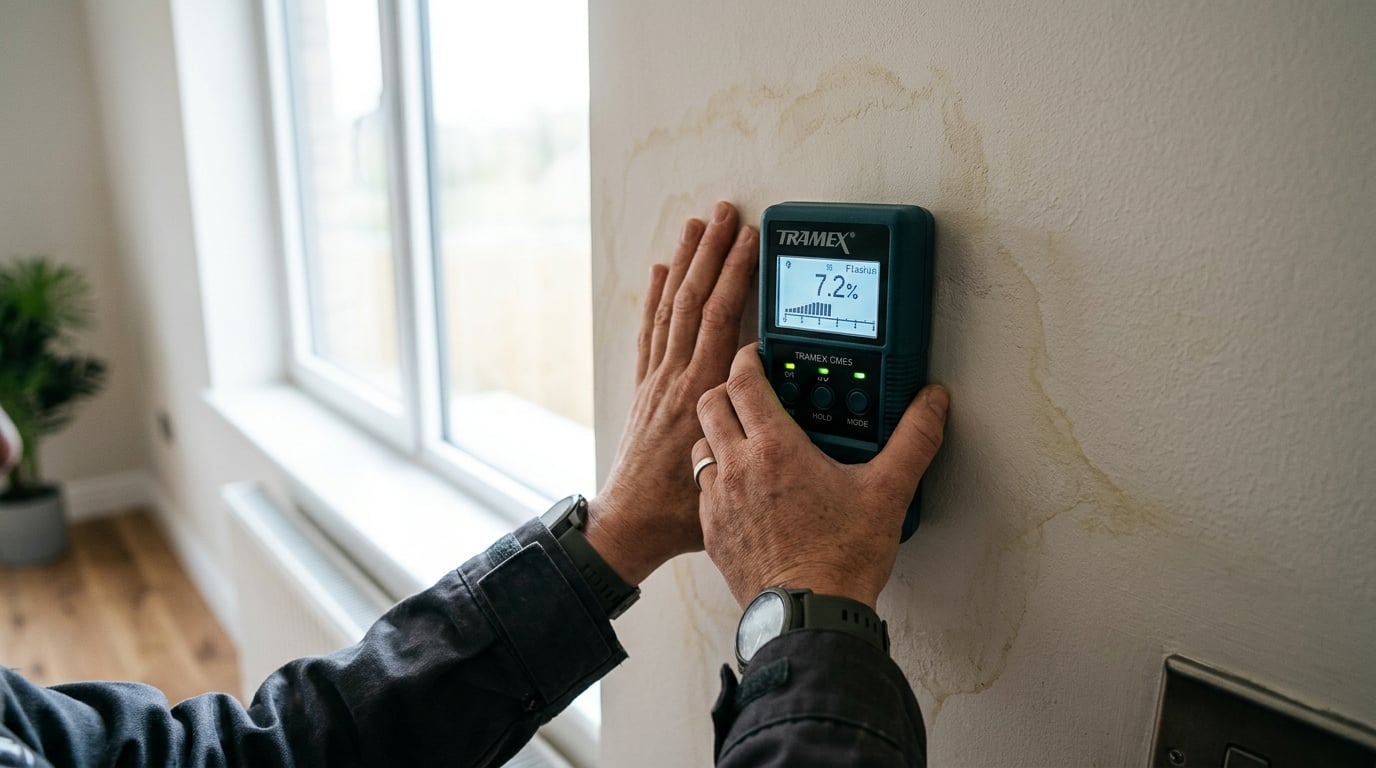
Your senses are the first instrument. A persistent musty smell often marks hidden growth before anything is visible; discoloration, bubbling paint, warped flooring and swollen baseboards mark where water has been. But because the most damaging moisture hides inside walls, floors and ceilings, two inexpensive tools dramatically improve your odds.
A moisture meter reads the moisture content of a material, letting you compare a suspect wall to a known-dry one and trace a damp trail back toward its source. A hygrometer measures relative humidity in the air, telling you whether the whole space is running too wet. For deeper investigation, professionals add infrared cameras (which reveal temperature differences from evaporative cooling behind surfaces) and borescopes for peering into cavities.
- Trust your nose — a musty odor is meaningful even without visible mold.
- Use a moisture meter to compare suspect materials to dry references and trace the trail.
- Use a hygrometer to confirm whether indoor humidity is chronically too high.
- Inspect after rain and during humid weather, when leaks and condensation reveal themselves.
- Check the usual hiding places: under sinks, behind appliances, around windows, in the basement and crawlspace.
Key point: A moisture meter and a hygrometer together turn a guessing game into an evidence-based hunt.
Fixing the source by pathway
Once you have identified the pathway, the repair follows logically. The goal is to make the water stop arriving, not merely to mop up what already came.
- Plumbing: repair or replace the failing supply line, drain, seal or fixture; do not just dry the puddle.
- Roof & exterior: fix roofing and flashing, clean and redirect gutters and downspouts, and improve grading so soil slopes away from the foundation.
- Condensation: add insulation to cold surfaces, improve ventilation (bath and kitchen exhaust fans vented outside), and address single-pane windows.
- High humidity: run a dehumidifier, ventilate, stop drying laundry indoors, and keep indoor relative humidity around 30–50%.
Drying a building correctly
Speed is everything. Many molds begin colonizing wet material within 24 to 48 hours, so the window between wetting and thorough drying is the whole game. Move fast and completely: remove standing water, increase airflow with fans, pull moisture from the air with a dehumidifier, and verify with your moisture meter that materials have truly returned to dry — not just that the surface feels dry to the touch.
Some materials cannot be salvaged once saturated. Porous items — drywall that wicked water, carpet padding, ceiling tiles, insulation, upholstered furniture — often trap moisture and mold deep inside and are usually removed and replaced rather than dried. Non-porous materials like sealed tile, metal and glass can typically be cleaned and dried and kept.
Can it be dried and saved, or should it be removed?
| Material | Usual outcome after significant wetting |
|---|---|
| Sealed tile, metal, glass, solid plastic | Clean and dry — usually salvageable |
| Solid wood (caught early) | Often dries if addressed quickly |
| Drywall (saturated) | Usually cut out and replace |
| Carpet padding | Usually discard |
| Insulation, ceiling tiles | Usually discard |
| Upholstered/porous furniture (soaked) | Often discard if not dried within ~48 hrs |
Key point: Dry within 24–48 hours and verify with a meter. Saturated porous materials are usually removed, not rescued.
DIY cleanup vs. professional remediation
Not every mold job needs a professional, and not every job is safe to do yourself. Honest self-assessment here protects both your wallet and your health. General guidance (consistent with EPA recommendations) uses the size and nature of the problem as the dividing line.
Small areas of visible mold on hard, non-porous surfaces — roughly under 10 square feet, about a 3-foot by 3-foot patch — can often be handled by a healthy, well-protected homeowner. Bigger contamination, water-damaged porous materials, mold inside HVAC systems, any sewage or contaminated-water involvement, or a household member who is highly sensitive, asthmatic or immunocompromised all push firmly toward hiring a qualified remediation professional.
When to DIY and when to call a professional
| Situation | Recommended approach |
|---|---|
| Under ~10 sq ft on non-porous surface | DIY may be reasonable with proper protection |
| Large area or multiple rooms | Professional remediation |
| Saturated drywall, carpet, insulation | Professional remediation |
| Mold in HVAC / ductwork | Professional remediation |
| Sewage or contaminated (black) water | Professional — do not DIY |
| Sensitive, asthmatic or immunocompromised occupant | Professional remediation |
Doing DIY cleanup safely
If the job is genuinely small and non-porous, do it carefully. Protect yourself, contain the mess, and remember that the point is removal, not just discoloration control.
- Wear protection: a fitted N95 or P100 respirator, gloves and eye protection.
- Contain the area and avoid spreading spores to clean rooms; keep the space ventilated to the outside.
- Clean non-porous surfaces with detergent and water; you do not need bleach for most jobs, and bleach does not fix wet materials.
- Discard porous materials that are moldy rather than trying to salvage them.
- Dry thoroughly afterward and keep verifying with a hygrometer that humidity stays in range.
Key point: Removal plus drying beats disinfecting a still-damp surface. Bleach on wet drywall is not remediation.
Hiring remediation the smart way
When you do hire out, structure the job to protect your interests. The most important safeguard is independence: an inspector who also sells you the remediation has a built-in conflict of interest. Wherever possible, use an independent assessor to diagnose and verify, and a separate contractor to do the work.
- Prefer an independent inspector who does not also sell remediation.
- Insist the scope addresses the moisture source, not just the visible mold.
- Expect containment, controlled removal of affected materials, and proper cleanup.
- Consider independent post-remediation verification (for example, a repeat dust test or HERTSMI-2) to confirm success.
- Get the moisture problem fixed in writing so it cannot simply recur.
Preventing the next water problem
Once the source is fixed and the building is dry, a little maintenance keeps it that way. Prevention is almost entirely moisture management, and most of it is cheap.
- Keep indoor humidity around 30–50% and check it with a hygrometer.
- Fix leaks immediately and dry any wetting within 24–48 hours.
- Maintain gutters, downspouts and grading so water flows away from the building.
- Ventilate bathrooms, kitchens and laundry areas to the outside.
- Inspect high-risk areas seasonally: basements, crawlspaces, roofs and around windows.
Key takeaways
- Mold is a moisture problem — find and fix the water source before you clean anything.
- Most indoor moisture comes from four pathways: plumbing, roof/exterior, condensation and high humidity.
- A moisture meter and hygrometer turn the search into an evidence-based hunt.
- Dry affected materials within 24–48 hours; saturated porous materials are usually removed.
- Small non-porous areas may be DIY with protection; big, saturated or HVAC/sewage jobs need professionals — ideally with an independent inspector.
Frequently asked questions
How do I find a hidden water leak causing mold?
Start with your senses — a musty smell, stains, bubbling paint or warped flooring mark where water has been. Then use a moisture meter to compare suspect materials to dry references and trace the damp trail toward its source, and a hygrometer to check whether the whole space is too humid. Inspect after rain and check under sinks, behind appliances, around windows and in the basement and crawlspace. Professionals can add infrared cameras for hidden moisture.
How quickly do I need to dry water damage to prevent mold?
As fast as possible — ideally within 24 to 48 hours. Many molds begin colonizing wet material in that window, so removing standing water, running fans and a dehumidifier, and verifying dryness with a moisture meter promptly is what actually prevents growth.
Can I remove mold myself or do I need a professional?
Small areas of visible mold on hard, non-porous surfaces (roughly under 10 square feet) can often be cleaned by a healthy, well-protected homeowner. Larger areas, saturated porous materials like drywall and carpet, mold in HVAC systems, any sewage or contaminated water, or a sensitive, asthmatic or immunocompromised occupant call for a qualified remediation professional.
Should I use bleach to clean mold?
For most small jobs you do not need bleach — detergent and water on non-porous surfaces is effective, and the key steps are removing the growth and drying the material. Bleach does nothing to fix wet materials or the underlying leak, and porous moldy materials should be discarded rather than disinfected. Never mix bleach with ammonia or other cleaners.
Why does my mold keep coming back after I clean it?
Because the moisture source was never fixed. Cleaning removes the visible growth but not the water feeding it, so the colony returns. The durable fix is to find and stop the leak, condensation or humidity source, dry the materials completely, and only then clean or remediate.
Should the same company inspect and remediate my mold?
Ideally no. An inspector who also sells the remediation has a conflict of interest. Where possible, use an independent assessor to diagnose the problem and verify the result, and a separate contractor to perform the work, so the assessment stays unbiased.
Helpful tools for this topic
Educational suggestions — not endorsements. Explore neutral options in the marketplace.
Moisture meter
Detects elevated moisture in walls, wood and flooring so you can find the source before mold takes hold or after a leak.
Explore optionsDehumidifier
Pulls moisture out of the air to hold relative humidity in the 30–50% range, removing the conditions mold needs to grow.
Explore optionsCertified mold inspector
An independent inspector assesses the building, finds the moisture source and documents the extent — ideally separate from the company doing the removal.
Explore optionsHEPA air purifier
True-HEPA filtration captures fine airborne particles including mold spores. Sizing the unit to the room (by CADR) matters more than brand.
Explore optionsFree mold-risk assessment
Turn your symptoms and environment into clear next steps in minutes.
Start freeBook a consultation
Get physician-supervised testing and a personalized recovery plan.
See programsReferences & further reading
- EPAU.S. EPA — Mold Cleanup in Your Home
- EPAU.S. EPA — Mold Remediation in Schools and Commercial Buildings
- CDCCDC — Mold: cleanup and remediation guidance
- FEMAFEMA — Dealing with flood-damaged and water-damaged buildings
This article is for general education only and does not diagnose, treat or replace care from your own licensed clinician. MoldDetox.ai provides physician-supervised, educational health services. It does not provide emergency care. Testing and recommendations support — but do not replace — evaluation by your own licensed clinician.